
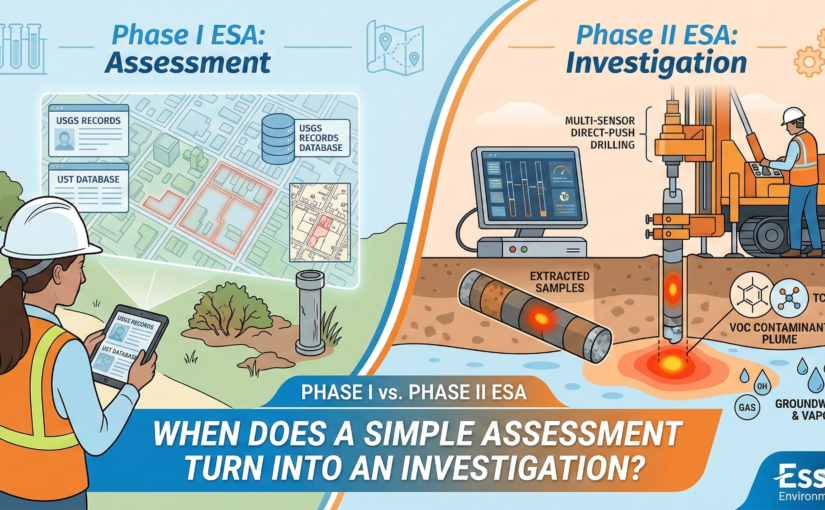
In the world of commercial real estate and land development, “due diligence” is the shield that protects buyers, lenders, and developers from multi-million dollar liabilities. At the heart of this protection are two distinct processes: the Phase I Environmental Site Assessment (ESA) and the Phase II Environmental Site Assessment.
While they sound similar, they serve entirely different purposes. One is a historical deep dive; the other is a physical interrogation of the earth.
Phase I ESA: The “Paper Trail” Detective
A Phase I ESA is generally the starting point for any property transaction. Think of it as a background check for land.
The goal of a Phase I is to identify Recognized Environmental Conditions (RECs). An environmental professional conducts this without ever breaking the surface of the ground.
What’s Included?
- Records Review: Checking federal, state, and local databases for past spills, underground storage tanks (USTs), or hazardous waste activity.
- Site Reconnaissance: A visual “walk-through” to look for distressed vegetation, stained soil, or mysterious vent pipes.
- Interviews: Speaking with past and present owners or neighbors.
- Historical Research: Reviewing aerial photos, fire insurance maps (Sanborn maps), and city directories dating back decades.
The Outcome: A Phase I ends in a report that either gives the property a “clean bill of health” or identifies RECs that require further investigation.
The Turning Point: When Does Phase I Become Phase II?
The transition from a Phase I to a Phase II isn’t a choice made by a coin flip; it’s driven by the discovery of a “smoking gun.”
A Phase I turns into a Phase II investigation when the preliminary assessment reveals a high probability of contamination. Common triggers include:
- Historical Use: The property was previously a gas station, dry cleaner, or industrial plant.
- Adjacent Risks: A neighboring property has a documented chemical leak that may have migrated onto your site.
- Physical Evidence: The inspector found an unregistered underground tank or significant chemical staining during the site visit.
Phase II ESA: The “Physical Investigation”
If Phase I is about potential risk, Phase II is about actual proof. This stage involves getting “dirty” to determine the presence, type, and concentration of contaminants.
What’s Included?
Unlike the Phase I, this stage is invasive and customized to the specific RECs found earlier.
- Soil Sampling: Boring into the earth to collect samples at various depths.
- Groundwater Testing: Installing monitoring wells to see if plumes of chemicals are moving through the water table.
- Sub-Slab Vapor Intrusion: Testing the air beneath a building’s foundation to see if volatile organic compounds (VOCs) are off-gassing into the indoor environment.
Comparing the Two: At a Glance
| Feature | Phase I ESA | Phase II ESA |
| Primary Goal | Identify potential contamination (RECs). | Confirm/Quantify actual contamination. |
| Methods | Records, interviews, visual inspection. | Drilling, sampling, lab analysis. |
| Invasiveness | Non-invasive (no holes drilled). | Invasive (soil/water extraction). |
| Duration | Typically 2–3 weeks. | Typically 4–6 weeks (including lab time). |
| Required By | Lenders, insurers, and “Innocent Landowner” protections. | Required if Phase I finds significant RECs. |
Why You Shouldn’t Fear the Phase II
Many developers see a Phase II as a “deal killer.” In reality, it is a deal saver.
Identifying a $\$50,000$ soil remediation issue before you close on a property is much better than discovering a $\$500,000$ liability after you’ve started construction. A Phase II provides the data needed to negotiate the purchase price or require the seller to perform a cleanup before the title transfers.
The Bottom Line
A Phase I tells you if there might be a problem. A Phase II tells you exactly what the problem is, how big it is, and how much it will cost to fix.
At Essel, we specialize in moving projects from uncertainty to clarity. Whether you need a standard Phase I for a bank loan or a complex Phase II subsurface investigation, our team ensures your investment is built on solid, clean ground.
Do you have a property with a “checkered past”?
Contact Essel today to schedule your Phase I ESA and ensure your due diligence is handled by the experts.