
For real estate investors and developers, few things are as unsettling as receiving a Phase I Environmental Site Assessment (ESA) flagged with a REC. In the industry, “REC” stands for Recognized Environmental Condition, and while it may sound like a bureaucratic footnote, it is arguably the most critical three-letter acronym in your property report.
At Essel Environmental, we help clients navigate these findings daily. Understanding the “REC Reality” is about moving past the initial alarm and using the data to make an informed, risk-adjusted investment.
What is a REC? (The 2026 Definition)
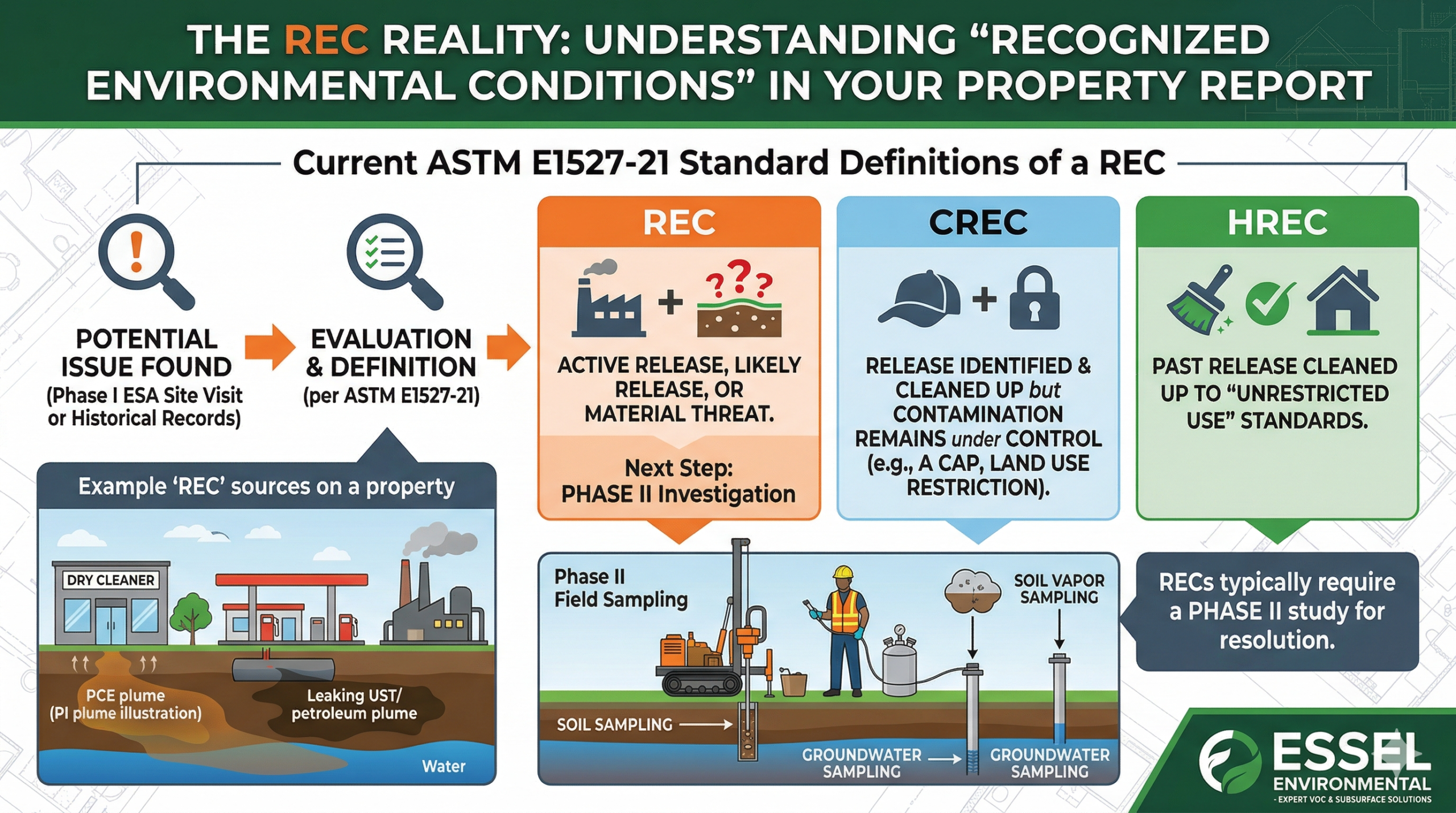
Under the current ASTM E1527-21 standard, a Recognized Environmental Condition is defined as:
- The presence of hazardous substances or petroleum products in, on, or at a property due to a release to the environment.
- The likely presence of these substances due to a release (past or present).
- A material threat of a future release to the environment.
In simpler terms, an environmental professional has found evidence—either through historical records, site observations, or nearby contamination plumes—that suggests the property’s soil, groundwater, or soil vapor might be impacted.
Deciphering the “Alphabet Soup”: REC vs. HREC vs. CREC
Not all “conditions” are created equal. Your report might categorize findings into three distinct buckets:
| Term | What it Means | Impact on You |
| REC | An active or likely environmental concern. | Usually requires a Phase II Investigation (sampling). |
| HREC (Historical) | A past release that has been cleaned up to “unrestricted use” standards. | Generally “clean”—no further action required. |
| CREC (Controlled) | A past release that was cleaned up, but contamination remains under “controls” (e.g., a cap or land-use restriction). | You must maintain the controls; limits how you can use the land. |
Pro Tip: A “De Minimis” condition is not a REC. These are minor issues (like a small, superficial oil stain on a concrete floor) that don’t pose a threat to health or the environment.
Common “Red Flags” that Trigger a REC
In our experience across the U.S., certain historical land uses are magnets for RECs. If your subject property includes any of these, expect a REC in your report:
- Dry Cleaners: Even if they closed decades ago, solvents like PCE (Perchloroethylene) persist in the soil for a very long time.
- Gas Stations: Leaking Underground Storage Tanks (LUSTs) are the most common source of petroleum RECs.
- Industrial Fabricators: Historic use of degreasers and heavy metals.
- Adjacency: If the property next door has a known chemical plume, it could be migrating toward your boundary.
The Financial Stakes: Why RECs Matter
A REC isn’t just a technicality; it has real-world financial implications:
- Lender Hurdles: Most banks will refuse to fund a loan until a REC is either cleared by a Phase II study or a remediation escrow is established.
- Liability Protection: To qualify for “Innocent Landowner” protections under CERCLA, you must perform “All Appropriate Inquiries.” Ignoring a REC in your report can strip you of these legal defenses.
- Property Devaluation: Unaddressed RECs create “stigma,” making the property harder to sell or refinance later.
Your Next Step: From REC to Resolution
If your Phase I ESA identifies a REC, don’t panic. It is a signal to perform more targeted due diligence. The standard next step is a Phase II Environmental Site Assessment, which involves physical sampling of soil, water, or vapor to confirm if the “likely presence” is an “actual presence.”
At Essel Environmental, we specialize in turning these “hidden liabilities” into manageable data points. From initial Phase I reports to complex VOC-related services and remediation oversight, our team ensures your investment is built on solid, clean ground.
Do you have a Phase I report with a REC that needs a second look? Contact Essel Environmental today for a expert consultation on your VOC and subsurface investigation needs.