
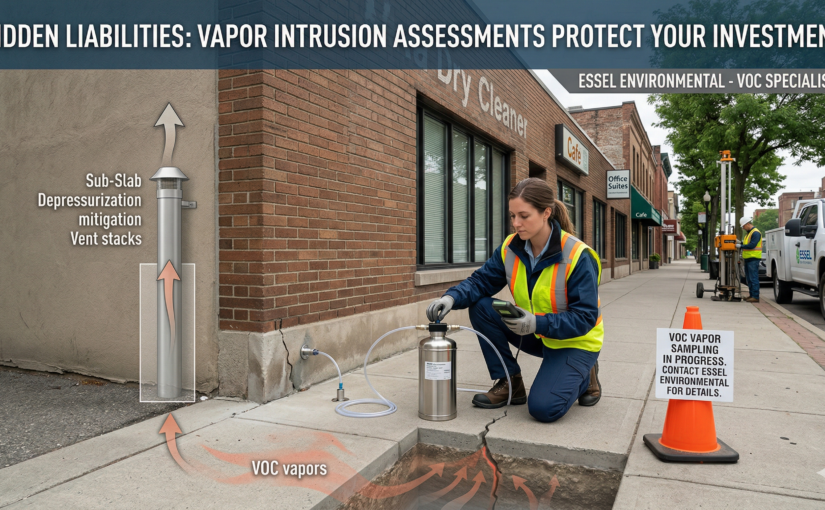
In the high-stakes world of commercial and industrial real estate, due diligence is often focused on the visible: structural integrity, roof conditions, and surface-level aesthetics. However, some of the most significant financial and legal liabilities are completely invisible to the naked eye. Among these, Vapor Intrusion (VI) has emerged as a critical risk factor that can derail acquisitions, complicate financing, and lead to decades of litigation.
As environmental consultants, we have seen firsthand how failing to account for “the air beneath the floor” can turn a promising investment into a stranded asset. Here is an in-depth look at why Vapor Intrusion assessments are no longer optional for the modern investor.
What is Vapor Intrusion?
Vapor intrusion is the process by which hazardous volatile chemicals in the soil or groundwater migrate into the indoor air of overlying buildings. These chemicals typically Volatile Organic Compounds (VOCs) evaporate and move through the pore spaces in the soil. They eventually enter a structure through cracks in the foundation, utility penetrations, or even through the porous nature of concrete itself.
Common sources of these vapors include:
- Historical Dry Cleaners: Releases of tetrachloroethylene (PCE).
- Manufacturing & Industrial Hubs: Use of degreasers like trichloroethylene (TCE).
- Former Gas Stations: Leaking underground storage tanks (USTs) releasing benzene and other petroleum hydrocarbons.
- Off-Site Migration: Contamination doesn’t respect property lines; vapors from a neighboring dry cleaner can easily migrate under your building.
The Evolution of Due Diligence (ASTM E1527-21)
The industry standard for environmental due diligence, the ASTM E1527-21, has solidified the requirement for environmental professionals to consider the “vapor pathway.” In the past, many investors relied on a standard Phase I Environmental Site Assessment (ESA) that focused primarily on soil and groundwater.
Today, if an environmental professional identifies a potential for vapor migration, it is classified as a Recognized Environmental Condition (REC). Ignoring this finding can invalidate your “All Appropriate Inquiries” (AAI) protection under CERCLA, potentially making you liable for millions in cleanup costs you didn’t cause.
Why the Risk is Growing in 2026
Regulatory scrutiny regarding indoor air quality has never been higher. Federal and state agencies are consistently lowering “screening levels” the concentration at which a chemical is considered a risk.
- Lower Action Levels: What was considered “safe” five years ago may now trigger mandatory mitigation under 2026 guidelines.
- Health-Based Liability: Long-term exposure to VOCs like TCE has been linked to severe health issues, including cardiac defects and cancer. As a property owner, you face significant “toxic tort” liability if tenants are exposed to these vapors.
- Lender Requirements: Banks and institutional investors are increasingly savvy. Most will not provide funding for a property with a “Vapor Encroachment” risk until a Phase II assessment or a mitigation plan is in place.
The Assessment Process: Beyond the Surface
A dedicated Vapor Intrusion Assessment moves beyond historical records into physical science. The goal is to build a Conceptual Site Model (CSM) that tracks the path of the chemical from the source to the lungs of the occupant.
- Sub-Slab Soil Gas Sampling: By drilling small, temporary holes through the floor slab, we can sample the air directly beneath the building. This provides the most accurate picture of what is “waiting” to enter the indoor space.
- Indoor Air Quality (IAQ) Testing: This measures the actual air occupants are breathing. However, this can be tricky, as common household items like cleaners, new carpets, or paints also release VOCs (known as “background interference”).
- Pressure Testing: We analyze how the building’s mechanical systems interact with the soil, as many modern HVAC systems inadvertently create a vacuum that “sucks” vapors out of the ground.
Turning Liabilities into Managed Assets
The discovery of vapor intrusion does not have to kill a deal. If caught early, the costs of mitigation can be factored into the purchase price or handled through environmental insurance. Modern solutions are highly effective:
- Sub-Slab Depressurization (SSD): Similar to radon systems, these use fans to create a low-pressure zone beneath the building, venting vapors safely above the roofline.
- Vapor Barriers: High-performance membranes (like spray-applied liners) installed beneath the slab during construction or renovation to block chemical entry.
- Institutional Controls: Legal restrictions that ensure mitigation systems remain active and the property is used in a way that minimizes exposure.
Protect Your Portfolio with Essel Environmental
Navigating the complexities of VOCs and subsurface contamination requires a partner who understands the intersection of environmental science and real estate finance. At Essel Environmental, we specialize in identifying these hidden liabilities before they become your problem.
Whether you are conducting a routine Phase I ESA or require advanced sub-slab vapor testing, our team provides the clarity and data you need to move forward with confidence. Don’t let invisible vapors evaporate your investment’s value.
Would you like a complimentary review of your property’s historical records to see if a Vapor Intrusion Assessment is recommended for your next acquisition? Contact Us.